Tuesday, November 12, 2013


From my bicycle ride today:  The trick is to find beauty in nature even where there are grotesques.


Monday, November 11, 2013

OUT THERE…


Our sun is one of at least 200 billion stars in the Milky Way galaxy… and our galaxy is one of over 100 billion galaxies in the observable universe. In this period of my life known as retirement, I’ve had time to think about the sizes, distances, times and relationships of the stuff out there in the awesome space we call the Cosmos… Greek word κόσμος, which is also known as the Universe, all existing matter and space considered as a whole.


I’ve had the good fortune to know two astronauts who have left Earth orbit and travelled out to the moon.  I became acquainted with William “Bill” Anders when I was headmaster at the Potomac School in the 70s and 80s. Bill, with Frank Borman and James Lovell, was one of the first three persons to leave Earth Orbit (Apollo 8 in 1968).  These three were also the first to see the whole earth all at one time and the first to see the far side of the moon. I shall never forget the time he showed me photographs he took from space… especially his favorite photograph of “Earthrise.”   Ten years after their amazing journey, with voice bright but thick with emotion, Bill told me how moved he was every time he was “out of sight” of Earth as they orbited the moon ten times before heading home. Charles “Pete” Conrad, the third man to walk on the moon (Apollo 12) was an alumnus of the Darrow School (class of 1949) where I was headmaster for a time in the 80s. Pete died in a motorcycle accident in 1999.  Bill, now eighty, lives in Washington state. 


Since Apollo 8 and Apollo 12, we’ve all seen the marvelous photographs captured from relatively tiny sections of the galaxy by the Hubble Space Telescope (launched in 1990) and by the Kepler space observatory (launched in 2009). When Bill Anders and Pete Conrad made their journeys around the moon, they couldn’t see much more of the cosmos, except the moon close-up and the earth looking back on it, than we can see on any clear night in a dark place on earth.  Remembering Hubble and Kepler pictures, I thought about some of the pottery done by daughter Nancy… especially about the glazes she managed to fire onto one of my favorite bowls.  I decided that bowl should make my photos today.


Sunday, November 10, 2013


Sitting in church this afternoon for a funeral of a gay friend… 

Light in this space is absolutely stunning…
streams sometimes, like now… and
other times glows and grows slowly 
taking off the cloak from darkness.

The outer cloak covering disgrace, shame…
lifted in this celebration… a beginning
of removal altogether from the dark reality of
denial of full acceptance of all people.

A hero for me today is the associate pastor who declared in his eloquent, beautiful eulogy that our gay mutual friend, now deceased, and all people regardless of sexual orientation, should not be denied full participation in all ceremonies offered by the church to its members and to the wider community.  The minister affirmed the validity of love and commitment to mutual care of our friend and his partner.  

The minister today didn’t violate church law by officiating at a gay funeral, but he would be in jeopardy of losing his pastor’s credentials if he officiated at a gay wedding.  He is a brave man of honor and integrity, so I am confident that if he is asked to officiate in their wedding by a gay couple who declare their love for each other, he will do it. The risk for him is real. First United Methodist Church in San Diego where he is one of five full-time pastors accepts gay and lesbian members and does not make acknowledgment of heterosexual orientation a condition of employment.  The San Diego church, however, is a member of the 1,000-member General Conference which officially reaffirmed at its last worldwide meeting in 2012 it’s rejection of homosexuality as “incompatible with Christian teaching,” the language which was written forty years ago into the church’s  Book of Discipline. Clergy who perform same-sex unions risk punishment ranging from a reprimand to suspension to defrocking. Newspapers all across America are publishing an Associated Press report that a Methodist pastor faces ecclesiastical trial for officiating at his son’s gay wedding.  The trial is set to begin November 18 in Spring City, Pennsylvania. 

Hundreds of Methodist pastors, declaring that they are charged to minister to all people regardless of who they are and what they are, have publicly rejected the church’s doctrine regarding homosexuality as described in the Book of Discipline. Clearly the matter will not be resolved soon, so in the meantime pastors have permission to bury gay people but not to marry them. They may legally under church law administer other sacraments to gay people and presumably will continue to accept gladly for the church all financial contributions of LGBT members.

Saturday, November 09, 2013


Evo
lution they say
accounts for
just about
everything

that has
to
do
with 
survival

If you don’t get it right
you can’t stay in the game.

On
the oth
er
hand

it’s
clear 
there’s no
prep
aration for
some 
of the
things we 
encounter.

Wing it.


Friday, November 08, 2013

EARLY START
on another fantastic day in San Diego

5:30 this morning... on my way back home from taking friends to the airport, I stopped to capture the beginning of the day.  The image above is an iPhone photograph. The one below was taken with the little Sony point and shoot...  What a time this is when phones and little cameras can manage to get good picture in low light.  With a start like this, I'll continue through the day in AWE of everything.


 I went back and found the picture below that I took in 2009 on another early morning run to the airport... with the dramatically more expensive Nikon D2X.  I keep wondering... what next?


Thursday, November 07, 2013


REMEMBERING
J.F.K.


Wednesday, November 06, 2013

This BLOG writing isn't a rant.  It a record of serious thought and soul searching about my personal biases...

WHAT EVOLUTION MEANS… TO ME
How I am affected by it


I am, we all are, the still-in-progress result of evolution.  The scientific theory of evolution accounts for the development of life on Earth…and it is reasonable to assume that if biological populations are found to exist on other planets, their beginnings and development “out there” will be found to be the result of evolution.
The earth has been circling the sun for the 4.6 billion years.  For the last 3.6 billion years, simple cells (prokaryotes) have been on earth.  For the last 3.4 billion years, cyanobacteria have been performing photosynthesis.  Multicellular life has been present for the last billion years.  Simple animals appeared around 600 million years ago; mammals for the last 200 million years; birds for the last 150 million years; 130 million years ago, flowers; 60 million years, primates; and for the last 200,000 years, anatomically modern humans.  
O.K., O.K., O.K! I know something about what it means, in terms of evolution, that I pee standing up…, and how I grew to be six feet, two inches tall before old age started to shorten me.  I even know vaguely about how I came to be a “white man” with opposable thumbs and hazel eyes.  I am a believer.  Evolution is the explanation for what I am… at least for what the basic model of the person whom my parents gave the name Luther Jerral Miles was at a point of conception and now at age seventy-eight is still in the process of becoming. Since the moment of my birth until now the basic model of ME has been in a process of being “tricked out” considerably to include all kinds of attitudes, appetites, and attributes.
I have a pretty good idea how some of who I am and who I am becoming got layered on top of and incorporated into the basic citizen identified in the office of the San Diego County Registrar of Voters as Luther Miles, Democrat, 4th Supervisorial District, 53rd Congressional District, 79th Assembly District. I became a Democrat in an extended family with some other good, solid Democrats and lots of Republicans in it… actually, a liberal Democrat in an extended family with lots of moderate Republicans and a few conservative Republicans and probably even a few of those who identify with the Tea Party.  How did it happen… not to them, but to me?  Did evolution have anything to do with it? 
Did you notice in the previous paragraph how I used “good and solid” as adjectives to describe myself and other Democrats in my family… and how, I didn’t include any affirming adjectives, except “moderate” and “conservative” with members of the other party.  In this November issue of The Atlantic Monthly , Robert Wright reports on a recent wave of research suggesting “that our moral impulses have a firm biological function.”  In other words, I am a Democrat because my being one puts me into a group, and needing to be part of a group is a biological predisposition for individuals of my species. I wasn’t predisposed to become part of a particular group, but being “in group” was important.  Way back before any of my most recent ancestors in North America decided to join a political party and to identify with the other people in a political group, other much more distant ancestors realized the benefits of cooperation… within groups, and surviving long enough to procreate, they passed along to subsequent generations the inclination to be group related.  We are actually pretty good at getting along with one another in our own group, and at supporting the basic ethical rules that our group has established. The problem comes when various groups live in close proximity to each other, as in the present era with electronic media and ease of travel .   People in any group are likely to know what the basic values, what is considered unacceptable and what is thought to be moral, of his/her own group… and of other groups. Because the different groups (Muslims, Jews, Christians, Democrat, Republicans, etc.) have incompatible visions of what a moral society should be,  they fight.  Wright says research shows that most groups suffer from a deep bias— a tendency to overestimate their group’s virtue, magnify their grievances, and do the reverse with “the other group.”  Evolutionary psychologists claim a predisposition to developing group bias seems to be built into our species by natural selection… a particularly disturbing reality when we are trying to find common ground that might lead to peace.
Way back in time when there were relatively few people of our species sparsely populating a few areas of Earth, humans learned that three or four fellow hunter-gatherers could cooperate on a hunt to kill an animal that one individual couldn’t kill by himself. The tendency toward cooperation was passed along through natural selection until it became innate in the human species.  Group to group cooperation has to be learned because it is experienced as counter intuitive. We intuitively want our team to win, our tribe to be victorious.  Also passed along through natural selection is the impulse to expect the judgements of those in the group to which one belongs to be moral and just and the judgements of those in the other group to be immoral and unjust. 
Every now and then in the history of our species, an individual has appeared who has addressed the problem of group bias.  Jesus was one such person. He urged his followers to see the world from the point of view of others… to treat others the way they would like “the others” to treat them. It’s easier said than done because people in one group are easily convinced that people in “the other group” have contempt for their values. Some native American cultures placed value in learning to “walk in somebody else’s shoes.”

I’ve obviously got a lot more thinking to do. Although I don’t know him personally, I find myself not liking Ted Cruz… I admit to not liking him personally, to not wanting to like him.  If he moved into my neighborhood, I’d not like to welcome into it.  So, as I said, I’ve got some serious thinking to do. How much of my reaction to him and to others (I was going to say, “of his ilk,” but thought better of it,) is just ugly, embarrassing bias, and how much is reasoned response to political ideas which I find almost totally disagreeable and even dangerous?  I am a group person.  My biases are subtle… but they are there.


Tuesday, November 05, 2013


blue
GOES OUT
OR UP
sky
starts
HERE


Monday, November 04, 2013


Three years ago in 2010, 22% of American children under 18 lived in poverty.  The Breakdown isn’t surprising:  12.4% of white, not Hispanic children lived in poverty.  38.2% of Black children lived in poverty.  35% of Hispanic children...  13.6% of Asian children.  It is estimated that 13% of children in America are born into poverty and will likely not get out of it.  These statistics mean that one in five American children lives below the poverty level at some time during childhood, which puts America, the wealthiest nation of the world, at the very bottom of the ranking among other wealthy nations. Of the children living below the poverty level, more than half of them live in extreme poverty. Those are the ones who likely will not break out of it. Following the announcement that the food stamp program has been cut by Congress, how can politicians, and all of us, not be concerned about the poor, and especially about the children who regularly go to bed hungry.  

The Washington Post and the L.A. Times report today that about 47 million Americans who rely on food stamps for their meals will have to get by on less after their benefits were cut Friday.  The reports said that the cut was originally meant to be timed to a brightening economy, yet many Americans remain stuck in poverty.  About 14 percent of Americans are on food stamps. The program has grown rapidly in recent years, attracting the attention of deficit hawks, who note that it now costs taxpayers $75 billion a year. The legislation passed by the Republican-led House could lead to nearly 2 million Americans losing access to the program, according to congressional analysts. It would cut $40 billion over the next 10 years. 

The L.A. Times report says that in Texas, about 4 million people receive food stamps each month, a dramatic increase from 2.5 million five years ago. The latest cuts will drain $411 million from the state’s economy, said Celia Cole, chief executive of the Austin-based Texas Food Bank Network.  The Washington Post reports that Mississippi has the highest proportion of children 8 and younger considered low-income - - 63 percent. It’s not likely that conservative Republican governors Phil Bryant of Mississippi or Rick Perry of Texas will do any more to help people rise out of poverty than their predecessors Haley Barbour in Mississippi or George W. Bush did before them. It is obvious that the problems of poverty in America can be solved only when we have cooperation and compromise between the major political parties in federal and state governmental institutions. 
Compromise and cooperation are not likely to happen soon enough to help a whole generation of our poorest children stuck in abject poverty. Going to bed hungry is only one of many complications for the typical child growing up in poverty.  Poor children are more likely than those living above the poverty level to suffer from what psychologists call “toxic stress.”  Poor children are more likely to be exposed to violence, to be subjected to abuse, and to be deprived of adequate emotional support needed for normal cognitive development.  Poor children are typically not able to take advantage of pre-K education and therefore begin behind and continue to lag behind more privileged children after they begin compulsory elementary school.  The curse of poverty continues through childhood and adolescence.  A poor adolescent is more likely to become a teenage parent, and children born to young parents are likely to continue the cycle of poverty.  

What should be done?  What can be done?  Who can do it?  Of course, I don’t know how to eradicate poverty in America, but I continue to believe that the beginnings of support for children must happen at the grass roots level. City council members, county council members, and mayors must address the reality of children living in poverty directly… with determination to change whatever needs to be changed to give all children a chance to develop outside of environments overwhelmed by poverty. In the present political race to determine who will become San Diego’s next mayor, I want to know which of the candidates will commit to being the city’s leader in an effort to end poverty.  Leaders of community groups and organizations like churches must make eradicating poverty their first priority. Any pastor, priest, imam, rabbi or other religious leader who doesn’t accept as first priority the education of a congregation about our individual and community responsibility for the poor should find another line of work. Any politician who doesn’t demonstrate commitment to ending poverty in a district should be voted out of office.  People who are not committed to ending poverty, especially for children, are complicit in their deprivation and almost certain abuse.


Sunday, November 03, 2013


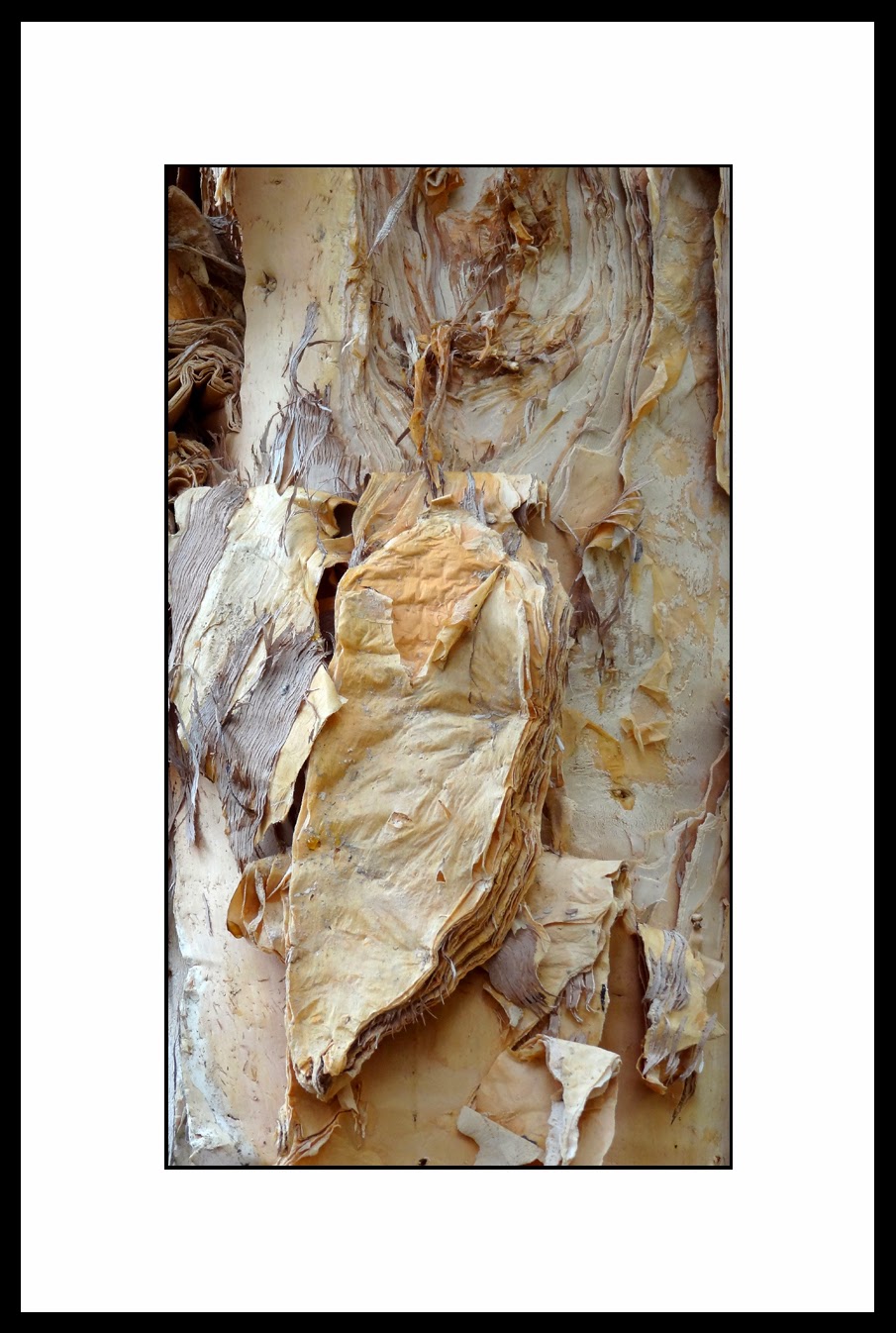
I like trees.  I am in awe of them.  
It’s worth remembering that trees are the largest living organism on earth… and some of the oldest living organisms. Bark is the outer part of a tree.  It’s a protective covering, like our skin is to us.  It protects the tree from injury, and on trees with very thick bark, like the Douglas fir, from temperature extremes. The moist, soft inner bark of a tree produces its annual rings.  It also serves as conduit for nutrients to the branches and trunk of the tree.  If bark is injured or cut down to the wood all the way around the tree, the tree can starve to death.

My pictures today are of the peeling bark of melaleuca quinuenervia.   Melaleuca, endemic mostly to Australia, is a genus of plants in the myrtle family.   They are sometimes called paperbark trees for obvious reasons.  When they are about three years old they begin to produce and store vast numbers of seeds which are stored in tightly closed woody capsules until some form of stress, such as frost, fire or human-induced injury, cause the capsules to open. In a single year a melaleuca can produce more than a million seeds.  It can store around 20 million.  When the woody capsule opens, seeds are dispersed by water and wind.


Some of my very good friends and I have been discussing evolution.  We’ve been exploring the implications in our individual and our loosely shared religious beliefs of our acceptance of the theory that trees and all other living organisms that exist today are the result of evolution. Shall I admit that in some mysterious way, I am glad to be related to the melaleuca tree which I photographed today… and to all things living. I am a teacher… was a teacher.  I am retired…  and I am appalled to learn that a significant number of American citizens are objecting, in the name of their Christian church, to including the theory of evolution in public school science classes. In some school districts, teachers of science are being required to include something called creationism in their science programs. 


Saturday, November 02, 2013


“CONSIDER THE LILIES…”
Schlumbergera truncata… I looked it up, and that’s what you call it if you’re a botanist.  The rest of us call it “Thanksgiving cactus.”  The only reason I know this one is Thanksgiving cactus is that it’s blooming now. The Christmas cactus looks exactly like this, but it begins its blooming season a month from now.  How does the one that’s blooming now know it isn’t a Christmas cactus?  I have no idea.  It’s a mystery. 
…And I’m in the mood for mystery… for enchantment.  Some of my friends and I are meeting every week for discussions around the idea that science and religion needn’t be considered contradictory fields of inquiry. In the first discussion our little group began with a quote by Vincent Van Gogh:  “When I have a terrible need of - - dare I say, ‘religion’ - - then I go outside at night and paint the stars.”   I can’t paint like Van Gogh; but I have a camera, and I go out to take pictures of mysteries close to home.
This week we will remind ourselves of the mystery by taking a look at one of my favorite poems:
thank You God for most this amazing day:
for the leaping greenly spirits of trees
and a blue true dream of sky; and for everything
which is natural which is infinite which is yes

(i who have died am alive again today,
and this is the sun’s birthday; this is the birth
day of life and love and wings: and of the gay
great happening illimitably earth)

how should tasting touching hearing seeing
breathing any-lifted from the no
of all nothing-human merely being
doubt unimaginable You?

(now the ears of my ears awake and
now the eyes of my eyes are opened)


- - e.e. cummings


Friday, November 01, 2013

Для вас, Антон, мой друг

SHARING SEASONS…


After Wednesday’s BLOG post about San Diego’s autumn, my extraordinary friend, Anton, who lives in Smolensk, Russia, sent photographs to me of real autumn, Russian Autumn. I’ve been there in summer, and a few years ago I spent a couple of months with Anton in the middle of Russian winter; but I’ve not had the pleasure of seeing Russian autumn with my own eyes.  Not yet.  

Anton’s photographs transport me to that beautiful place at the western edge of Russia where light has magic in it. He has given me permission to share his pictures on the BLOG. Dostoevsky’s words on yesterday’s BLOG post are perfect for these photographs of a place that the writer knew and loved. The first perfect landscape photograph doesn’t exaggerate the beauty of the Russian countryside.  It’s every bit as wonderful as that picture.  The shadow in the second picture is Anton, and in the next picture his son Danya and the Grandfather make an image that matches exactly the descriptions of families in Dostoevsky’s stories. чудесно!