Sunday, February 16, 2014
Saturday, February 15, 2014
I couldn't find a monarch butterfly... wrong season for it here; but I found another that I like... flitting around as if it were summer... and a bee working the winter Iceland poppies and the rosemary in our back yard.
NOT A MONARCH...
And speaking of working bees, my friend Clyde Yoshida of http://vibrantsoap.com/ was busy this morning... the outdoor market at Park and El Cajon Boulevards.
NOT A MONARCH...
Being something of an Arkansas traveler myself, I've been in love with the monarch butterflies since I first learned about their long trip when I was a little kid. My family moved from Arkansas to California when I was twelve, and the trip changed the world for me. I was the oldest of six kids making the trip, and I can remember not wanting to wear the sunglasses Mother bought for each of us because I wanted to see everything the way it was/is. I wear sunglasses now, but the impulse to see the rawness of things is still strong in me. I got over resisting the impulse to not let a lens come between me and reality. Now I'm committed to looking for truth through the lens of a camera.
Mrs. Mitchell, a science teacher at Live Oak High School, told me about the monarchs when I was in ninth grade. My family had traveled 1900 miles from Glenwood, Arkansas, to Live Oak, California... just about the same distance the monarchs fly. I've been in love with them since, and I admit to being afraid for them. With Montsanto and climate change working against them, I'm afraid these beautiful, heroic creatures will become extinct. Knowing that no single monarch ever makes the entire round trip almost turned me into a mystic when I was an adolescent. How could I not respect my own instincts and hunches if that little creature could find its way to a place two-thousand miles away where it had never been... My friend Jerome Garger reminded me today that the monarchs are in danger. Give it some thought. How do we persuade Montsanto to get on the side of the butterflies... instead of the side of the profit-at-all-costs god? How do we convince farmers that bees and butterflies are important to them, even if they don't feel kinship or respect for them? How do we turn stubbornly ignorant climate change deniers into believers in the possibility, even probability, of a world with much of the beauty and meaning gone from it?
And speaking of working bees, my friend Clyde Yoshida of http://vibrantsoap.com/ was busy this morning... the outdoor market at Park and El Cajon Boulevards.
Friday, February 14, 2014
Yesterday I wrote about a tree I know that has obviously seen tough times. I’m not a dendrologist or arborist… not even a biologist, so I can’t guess what might have caused its bruises and knots and twists. I know that I like that tree. It definitely has a history that isn’t placid and uneventful. The tree has character. I’ll never ride down that path again without looking at it with appreciation and respect… which brings me to the thought and the images that my blog writing today.
Growing in a flower pot on my back porch a beautiful succulent that I was given a long time ago is blooming in the middle of this winter. I don’t remember who gave it to me, and I don’t know the plant’s name. Perhaps I pinched it somewhere and started it by rooting it in the pot where it is growing. By pinched, I don’t mean I stole it. You know how easy it is to get a cutting to grow by sticking it in soil, even in sand. I think this is the first year that this one has bloomed. I’d have noticed it if it had bloomed last year or the year before. Some desert plants, like the century plant, die after they bloom… one dramatic display of fertility with a great stalk and flowers towering above most other neighboring plants… and than death. But that’s not the end. In that last burst of energy the mother plant surrounds itself with pups that grow up to be what adult plants are meant to be.
The century plant, Agave americana commonly also called maguey and American aloe, actually originated in Mexico before it was cultivated worldwide as an ornamental plant. Isn’t it typical that something that is as wonderfully beautiful as the century plant would be given Agave americana as its botanical name? After I wrote that last sentence I was hit with the thought that I guess I am no different from most other provincial U.S. Americans who think of the name America as a word which belongs to them us first. It does not belong only to the U.S. I reminded myself that Mexico and all those other Central American and South American people and places and plants are indeed AMERICAN… and that the history of some of them with the word can be dated back earlier than when it was used by the people who named my country “The United States of America.”
…another thing I’ve discovered about succulents, perhaps true of other plants but I don’t for sure, is that if you take a cutting and let it begin to dry a bit before sticking it into soil or sand to begin the rooting process, it will flourish more quickly than if you stick a freshly cut, wet stem into the rooting medium. My theory, just an observation, is that a succulent makes a great effort to stay alive if it is left alone and out of soil for a few days. Of course, the great body of world literature suggests that something like that is true of other living things… like our species, homo sapiens. Nothing like being at the very edge of annihilation to make an organism try harder to keep on living.
Checking the spelling of annihilation to be sure I got it right, I came upon a term in physics that I might have known once but had forgotten: pair annihilation… the process in which a particle and antiparticle unite, annihilate each other, and produce one or more photons.
YES!
Thursday, February 13, 2014
On my way home from the museum today I met a tree… one new to me... as I took a shortcut on my bicycle to avoid the dismount-and-walk rule that has been posted at the Cabrillo Bridge sidewalk. The tree is not as old as many of its neighbors, but I think it must have suffered more than most. It’s a gnarled stack of knots all the way up to a wild green tangle of spindly branches trying to break free from a distorted body. At other times I’ve been along this path; I don’t know why I hadn’t noticed the tree before today… but there it was staring at me as I came around a curve.
Wednesday, February 12, 2014
You know how it is… one thing leads to another… and then you wind up with something that at least resembles a poem. Actually, poetry can take almost any shape, any form. Sometimes I see as poetry a photograph that I’ve managed to get… or I see a photograph that someone else has captured that is sublime poetry; or it may be, depending on the subject, poetry that horrifies. This writing is going on longer than usual, but if you’ve read this far, perhaps you will indulge me. One of the photographs in the POWER exhibition at MOPA horrified me (Edmund Clark’s photograph Shackles at Guantanamo Bay Detention Facility), left me almost overcome with a residual sadness that intensified toward evening yesterday. I had volunteered to stay overnight at the Methodist Church where for two weeks a dozen people who are at least temporarily homeless are being offered shelter from five in the evening until seven in the morning. The program is sponsored and managed by San Diego Catholic Charities, with help from San Diego churches and synagogues. Margie L. and I were the two people on duty to put out supper, sleep overnight in the shelter area, and put out breakfast before the folks left at seven this morning. Those we hosted were mostly people with jobs who have for reasons that we did not know and didn’t ask about who had fallen on hard times. They spend two weeks in a “shelter” and then are moved to another place of shelter for another two weeks. In our group were four women, one teenage girl, and seven men. I’ve done this duty every year for at least one night and never fail to come away with a tremendous awareness of my own good fortune. This time, I didn’t take pictures… couldn’t intrude; but as I was having coffee with a friend later in the morning, I saw a woman moving along the street I guessed with whatever possessions she could carry with her after having to leave wherever it was that she had as shelter last night. I aimed my camera and got the photo du jour.
The poem spilled out later.
Homeless in the Land of Plenty
The eighth grader and her father
who has lost most of his teeth
are homeless in the land of plenty
and perhaps haven’t heard that this
is the land of the free and home of
brave dentists and good morning
America and a majority of well-paid
fat and sassy members of congress
who get their teeth fixed for free.
Anybody who has read the Bible knows
If you ain’t rich here, it’s your own fault
for not managing to get God on your side.
It’s as simple as praise the Lord and pass
the ammunition and keep your gun loaded
and at the ready to stand your ground
in case some kid on his way from school
especially if he is the color of chocolate
can’t explain why he’s in your neighborhood.
Jesus said you can get anything you want
if you ask for it right. Poverty is a disease.
If you’ve got that sickness it’s your fault.
If you can’t make it here, you can’t make it.
If you don’t believe me ask any rich man
who pulled himself up by his bootstraps
or whatever he had to pull on or suck on.
Here the means justify the end or anyway
you pays your money and takes your choice.
If you don’t have the stomach for politics
you’d probably just as well forget about it...
there probably ain’t no way for you to get rich.
——
Oh, by the way, My good friend Roz send me the following UTube video. It’s the perfect metaphor for what I’m talking about here. Watch it…if you dare.
Tuesday, February 11, 2014
MASTER TEACHERS... Kenton and Wendy brought their students to the Museum of Photographic Arts today and demonstrated how learning happens when adults begin by knowing they teach first who they are. I met Wendy for the first time today, but Kenton has been a valued friend whom I've known and admired as teacher and colleague. Their students are undocumented adolescents who exist in political limbo in the U.S. because they don't have "papers." They are just kids... but because they are stuck with the "undocumented label," it would be easy for them to think of themselves as substandard, inadequate, and unwanted. I watched today as Kenton, whose first language is English, spoke to the kids in fluent Spanish; and the very tone of his voice and the manner of his movements signaled to them that they are quite the opposite of substandard, inadequate, or unwanted. They come away from being with him knowing they are valued. He listens to them. He respects their opinions. He is outstanding.
We had other people in the museum today like these mothers teaching their young children the joy of books and museums and learning. Kenton and Wendy are determined in the short time they are with their adolescent students to give to them what these two mothers obviously want for their sons.
I found these left-over tulips in a storeroom in the museum and got this picture with my iPhone.
...couldn't resist...
Monday, February 10, 2014
The Ambiguity of Power
“Power is a potent word with two wholly contradictory meanings. For some it represents an exercise of control and domination over others that leaves the victim feeling imprisoned. For others it means opportunity and the ability to make radical change. When these two interpretations collide the result can be a shift in power relations, whether between the governors and the governed, between different ideologies, between economics and environmentalism, between men and women, or even between whole regions of the world.”
—from “The Power Paradox” by Phil Thornton for his essay published in the book Power by the European publishing group teNeues to accompany the Prix Pictet:Power exhibition of photographs at the San Diego Museum of Photographic Arts. The exhibition will be open to the public until May 18, 2014.
Prix Pictet, an annual juried prize, uses photography as an instrument to shed light on important social and environmental issues. Each year it selects one theme on which to focus. The first three themes were Water, Earth and Growth. Now in its 4th installment, Prix Pictet has selected Power as the subject of this year’s exhibition.
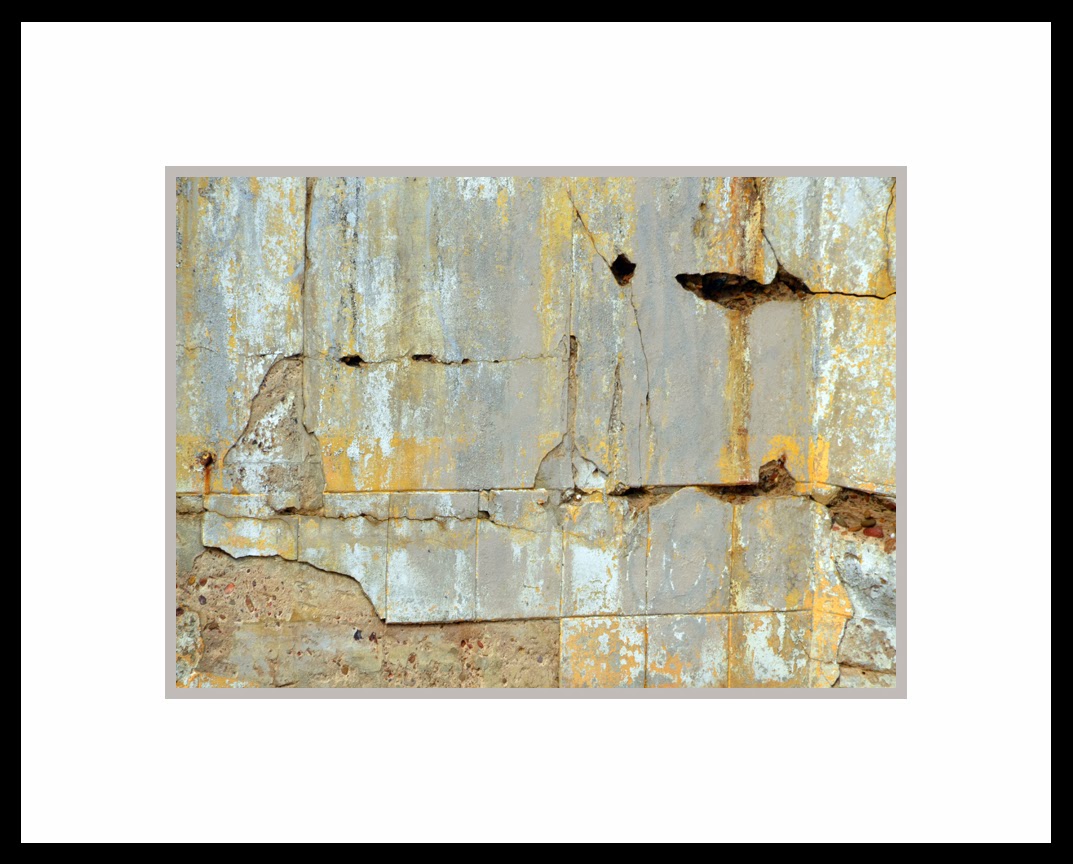
My photographs today are images of a wall at San Diego’s Ocean Beach… a wall built to hold back the sea’s waves in a storm. Together the images seem to me to be a metaphor for eroded power in human communities and institutions.
Sunday, February 09, 2014
Saturday, February 08, 2014
Walking this morning from the Museum of Photographic Arts to my car I got pictures from a couple of trees that caught my attention... and a splash of graffiti that someone, probably park grounds keepers, had covered over thinly with black paint. It wasn't until I downloaded the pictures from my camera to my computer when I got home that one of my favorite poems came to mind. The wrinkles in the bark of a ficus tree looked vaguely like part of a face I might have seen on an ancient monument. I'm in the habit of looking for markings on trees that look like eyes, and I found one of those on a eucalyptus tree. The other picture was the covered area of graffiti. I thought of Shelley's "Ozymandias." I guess it's just the way an old retired English teacher's mind works.
Ozymandias by Percy Bysshe Shelley
I met a traveller from an antique land
Who said: Two vast and trunkless legs of stone
Stand in the desert. Near them on the sand,
Half sunk, a shatter'd visage lies, whose frown
And wrinkled lip and sneer of cold command
Tell that its sculptor well those passions read
Which yet survive, stamp'd on these lifeless things,
The hand that mock'd them and the heart that fed.
And on the pedestal these words appear:
"My name is Ozymandias, king of kings:
Look on my works, ye Mighty, and despair!"
Nothing beside remains: round the decay
Of that colossal wreck, boundless and bare,
The lone and level sands stretch far away.
Who said: Two vast and trunkless legs of stone
Stand in the desert. Near them on the sand,
Half sunk, a shatter'd visage lies, whose frown
And wrinkled lip and sneer of cold command
Tell that its sculptor well those passions read
Which yet survive, stamp'd on these lifeless things,
The hand that mock'd them and the heart that fed.
And on the pedestal these words appear:
"My name is Ozymandias, king of kings:
Look on my works, ye Mighty, and despair!"
Nothing beside remains: round the decay
Of that colossal wreck, boundless and bare,
The lone and level sands stretch far away.
Friday, February 07, 2014
Cape Honeysuckle
Jutting its I dare you self into rain or wind or sun
from the moment it boldly rises from a timid bud
TheTecoma petersii in my backyard is all bluff
until it drops flaccid and spent into the inevitable
end of all magical shake and jive and whatever...
challenging and anticipating eager hummingbirds.
Thursday, February 06, 2014
Rain in San Diego today... A time to sift through some old photographs...
But, of course, I must include a couple from this day. The La Jolla Children's Pool has been taken over by seals... I got the cell phone picture last Saturday when Nancy was here. The others: Michael (now a senior at UC Santa Cruz) on his 3rd Birthday; Jeremy (now a sophomore at UC Santa Cruz) with Cody; Jeremy and Michael sleeping; Susanne and Dael.
The first picture: Balboa Park before the rain started... reminded me of "The Way I See It."
But, of course, I must include a couple from this day. The La Jolla Children's Pool has been taken over by seals... I got the cell phone picture last Saturday when Nancy was here. The others: Michael (now a senior at UC Santa Cruz) on his 3rd Birthday; Jeremy (now a sophomore at UC Santa Cruz) with Cody; Jeremy and Michael sleeping; Susanne and Dael.
The first picture: Balboa Park before the rain started... reminded me of "The Way I See It."
Wednesday, February 05, 2014
While biking on a familiar path along the river today, I revisited a couple of my favorite trees and was reminded again that for me the art of photography is a matter of finding something worth seeing, something that exists already and is waiting for me to come along with my camera. It’s been awhile since I posted bark photographs.
Subscribe to:
Posts (Atom)